Software development - design pattern
Finite State Machine (FSM)
Finite State Machine
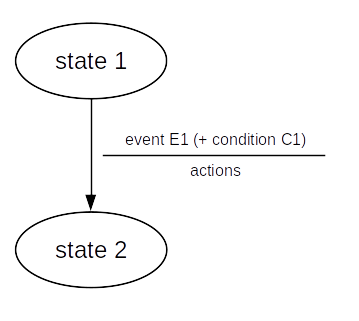
- Abstract machine having a finite number of states
- At a given time, is in one state
- Entering a new state (transition) is caused by an event
- A condition may guard a transition
- Processing is performed when transitioning
Also named Finite State Automaton (FSA)
A way to depict an FSM:
Example: a message receiver
A PC needs to send text messages to another PC. The two PCs are connected by a link with the following properties:
- Reliable (every sent byte is received, without error)
- In order
Every message is formatted as follows:
- Starts with the ASCII character STX (0x02)
- Ends with the ASCII character ETX (0x03)
- Message body contains alphanumeric characters (letters and numbers) only
- Message body contains a maximum of 255 characters
Possible FSM waiting for a full message:
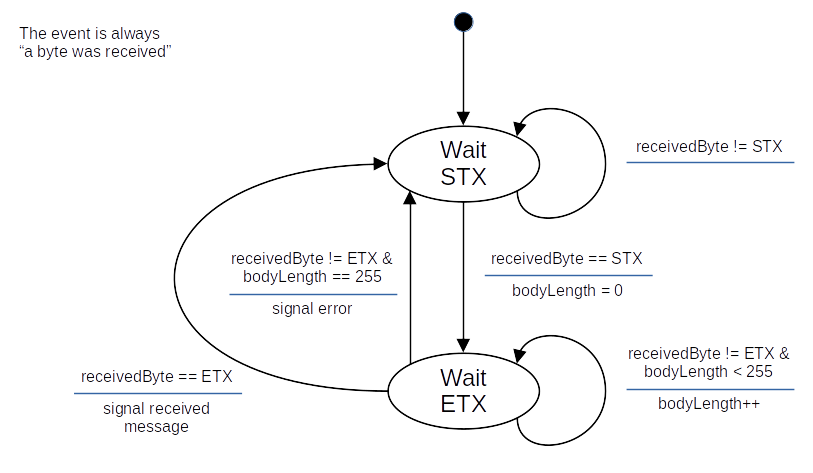
A possible implementation:
						current_state = WAIT_STX;

						while (true) {

							c = get_character();

							switch (current_state) {
							case WAIT_STX:
								if (c == STX) {
								  body_length = 0
									current_state = WAIT_ETX;
									break;
								}
								// At this stage, other character, stay in this state.
								break;
							case WAIT_ETX:
								if (c != ETX) {
								  if (body_length < 255) {
								    // TODO: store received byte.
								    body_length++;
								    // Stay in same state.
								    break;
								  }
								  // At this stage, body_length >= 255.
								  // TODO: signal error.
								  current_state = WAIT_STX;
								  break;
								}
								// At this stage, ETX.
								current_state = WAIT_STX;
								break;
							default:
								signal_error(UNKNOWN_STATE);
								current_state = WAIT_STX;
							}
						}