Communication
By communication we mean:
- Exchanging data between tasks
- Exchanging data between ISRs and tasks
Exchanging data is usually asynchronous: data producer may produce data at some time, while data consumer may try to consume data at another time.
Data exchange must be protected so that the consumer always gets consistent data.
It is desirable that a mechanism let the consumer know that there is some data to consume.
Queues
- Used to send messages between a source and a destination
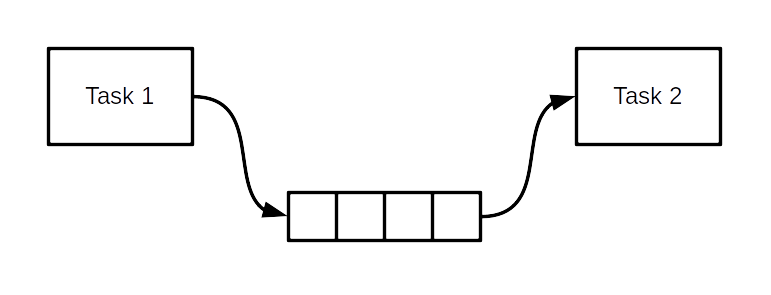
Usually:
- A queue is FIFO (First In First Out)
- The write operation returns immediately
- Trying to read from an empty queue blocks
- Trying to write into a full queue blocks or returns an error
- Messages are of fixed size (but may contain pointers)
- Messages are passed by copy
API example
queue_handle_t queue_create(int queue_length, int message_size)status_t queue_send(queue_handle_t qh, void *message, timeout_t timeout)status_t queue_receive(queue_handle_t qh, void *message, timeout_t timeout)status_t queue_delete(queue_handle_t qh)
Practice session 15
Using a queue
- Purpose: demonstrate how to use a queue
- What to do: follow the instructions provided by the
embedded-systems-for-ML/practice-sessions/15-Queue/README.mdfile
Queues: benefits - 1/2
- Ensure atomic access to messages
- Provide synchronization between tasks
Queues: benefits - 2/2
A useful tool to prevent priority inversion and deadlocks
⇒ In many cases, it's better to use queues instead of mutexes or semaphores.
A common design pattern: to provide access to a shared resource, use a "server" task with a queue. Clients write their requests into the queue.
Practice session 16
Time-stamped button presses
- Purpose: use a queue to handle button presses
- What to do: follow the instructions provided by the
embedded-systems-for-ML/practice-sessions/16-All-button-presses/README.mdfile
Practice session 17
A log server
- Purpose: correct the log messages problem detected in practice session 14
- What to do: follow the instructions provided by the
embedded-systems-for-ML/practice-sessions/17-Log-server/README.mdfile
Note: this practice session is a little bit more challenging than the previous ones.